Compare
Wax melts vs incense
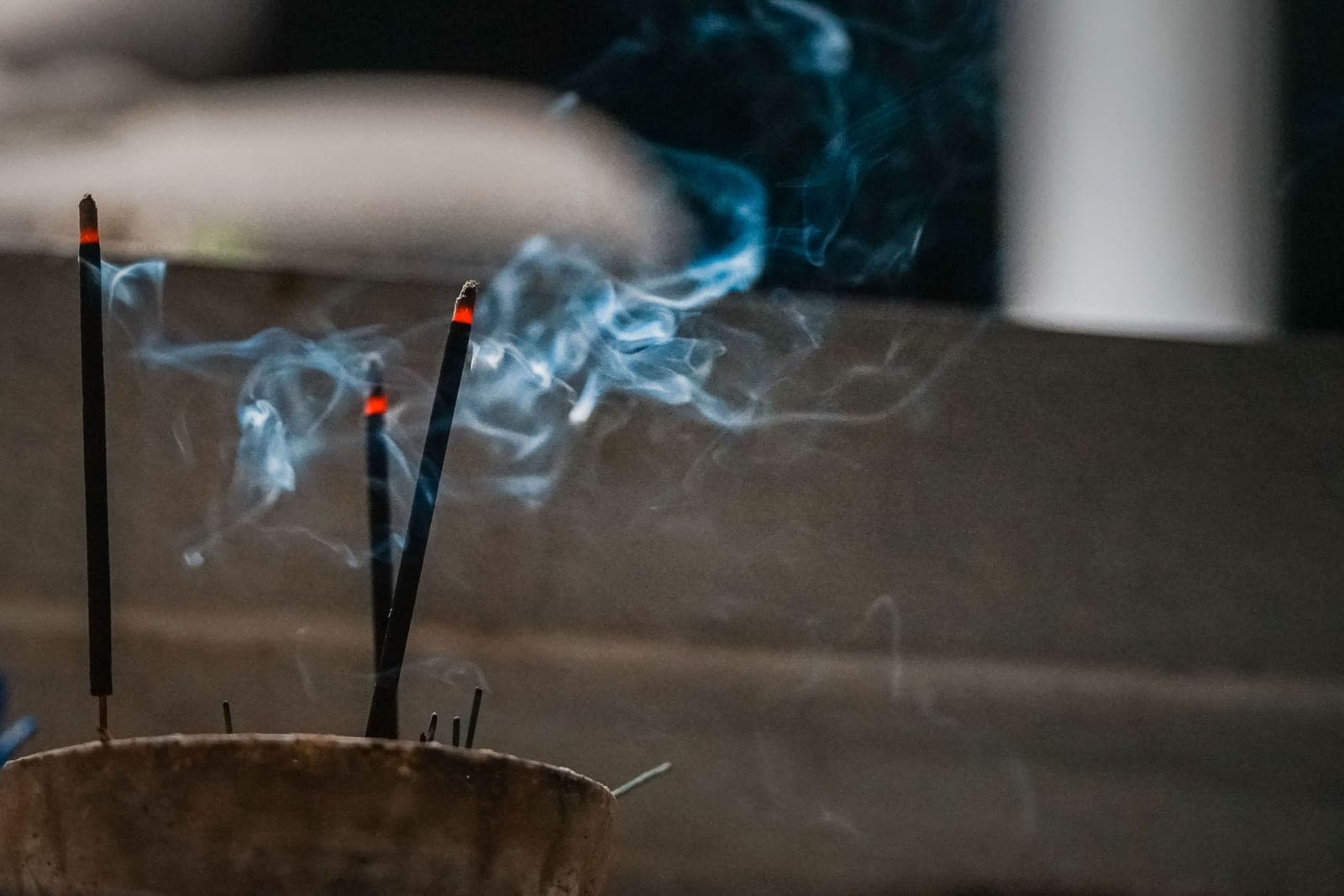
One of these burns plant matter in your living room and one warms wax. Everything else on this page follows from that single difference.
Disclosure — we earn a commission if you buy through the links on this page, at no extra cost to you. It does not change which products we pick or what we say about them. We accept no samples and no sponsorship. How this site is funded.
The short answer
Incense burns; a wax melt does not. A stick is combustion - it puts fine particulate into the room, leaves ash, and needs a flame to start. A warmed wax cube emits fragrance without burning anything, so there is no combustion particle at all, though it is not inert either. Incense is cheaper per session, needs no outlet, and does something to a room that no melt reproduces. But if you came to home fragrance to get rid of smoke, incense is not the flame-free option.
Quick picks
| # | Product | Best for | Price |
|---|---|---|---|
| 01 |  Colonial Candle Timer Warmer A plate warmer with a published timer and a named third-party safety listing, which together answer the two things campus housing rules actually ask about. | Best for a strict housing rule | $13.99 View on Amazon
|
| 02 |  EQUSUPRO Ceramic 3-in-1 Ships with both a ceramic and a silicone dish, which solves wax changes properly, but it publishes no wattage so we cannot cost it. | Best for changing scents often | $13.29 View on Amazon
|
| 03 | 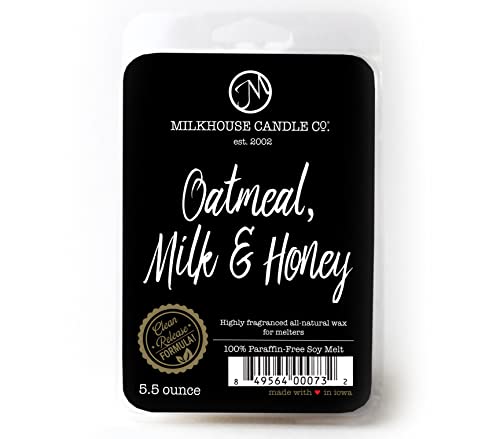 Milkhouse Soy Melts The heaviest pack here by some distance, 5.5 oz in six cubes against 2.6 oz in six from Yankee, which changes the price-per-ounce arithmetic completely. | Most wax per pack |
#ad Prices come from the live data layer and are stamped with the date they were checked. Where no live price exists the button says "Check price" rather than showing an old number. How we are funded.
The table
| Incense | Wax melts | |
|---|---|---|
| Open flame | Yes, to light it. Then a burning ember for the whole session. | None on any electric warmer. |
| Combustion | Yes. The scent IS the smoke. | No. The wax is warmed and the fragrance evaporates. |
| Particulate in the room | Measured, and comparable to biomass burning. | No combustion particulate. Fragrance VOCs, yes. |
| Residue | Ash, and a film on nearby surfaces over time. | Spent wax in the dish, which you lift out. |
| Control once it starts | Very little. Extinguish it and the smoke stays. | Switch off, or set a timer. Change scent in a minute. |
| Session length | Fixed by the stick - 20 minutes for the one we cite. | As long as you leave it on. Fragrance fades before the wax does. |
| Needs power | No. | Yes - 10 to 25 W, a few dollars a year. |
| Up-front cost | A box of sticks and a holder. The cheapest entry in home fragrance. | A warmer plus wax. Cheap, but not as cheap as a box of sticks. |
| Smoke alarms | A real consideration in a small room or hallway. | Not a factor. |
| Unattended use | No. It is a lit ember. | With a published auto shut-off, reasonable. |
Two rows carry the argument. Combustion is the one people arrive looking for, and control is the one they notice after a week. Incense is a commitment made at the moment you light it; a warmer is a decision you can undo.
What burning actually puts in the room
This is the part most comparisons either skip or exaggerate, so here is what has actually been measured.
A 2024 study in Environmental Science & Technology burned incense in a California residence and reported organic PM2.5 emission factors of 7 to 31 milligrams per gram of incense burned, varying by the type of incense. Its own summary of the chemistry is the line worth carrying away: incense particle emissions are chemically similar to organic aerosol from biomass burning. Not similar to a scented candle, and not similar to a perfume - similar to burning plant matter, because that is what it is.
A 2020 cohort study in PeerJ measured PM10 and PM2.5 in the homes of 18 Taiwanese outpatients with moderate-to-severe COPD while incense was burned. Two findings, and we are going to report both rather than only the alarming one:
- The air cleared. Both PM10 and PM2.5 were back to background levels one hour after burning. The authors' practical conclusion is that patients with COPD should avoid staying in a room where incense is burnt for up to an hour.
- Short-term lung function did not move. The same study reports that burning incense may not influence lung function or symptom severity in COPD patients over a short period - and flags its own small sample and short duration as limitations.
For scale, the EPA's national ambient air quality standards for PM2.5 are 9.0 µg/m³ as an annual mean and 35 µg/m³ over 24 hours. Those are outdoor ambient standards for regulators, not indoor limits for your living room, and anyone quoting them as a household threshold is misusing them. They are useful only as a reminder of the concentrations air-quality science thinks in.
Now the honest other half. A wax melt is not clean air. Warming fragranced wax releases volatile organic compounds - that is the mechanism by which you smell it - and we have written at length about how little is settled there on whether wax melts release toxins. The difference between these two products is not purity. It is that one of them adds combustion particulate to the room and the other one does not.
Twenty minutes of scent, and what it costs
The two products meter fragrance completely differently, and it changes how you use them.
A stick is a single-use object with a fixed run time. Shoyeido publishes an approximate burning time of 20 minutes per stick for its 2.75-inch River Path sticks. When it is gone it is gone, and a second stick is a second decision. That is genuinely pleasant - it makes the scent an event rather than a background condition - and it is also why a heavy incense habit adds up.
A wax cube goes the other way. It stays in the dish and gets re-melted until the fragrance is spent, which happens well before the wax stops being liquid - the mechanism behind the most common complaint in this whole category, covered on why you cannot smell your own wax melts. One cube is several sessions, not one.
On money, both are cheap and the difference is where the money goes. Incense is the lowest-cost entry in home fragrance: a box of sticks and something to stand them in. Wax melts need hardware first, and the warmers we index sit in the same bracket as a mid-range box of sticks. After that the wax is the recurring cost and the electricity is close to noise - a 10 to 25 W warmer at 17 cents per kilowatt-hour is a few dollars a year, with the arithmetic shown on how much electricity a wax warmer uses.
We are not going to publish a cost-per-hour table pitting the two against each other, because it would be dishonest: incense pricing runs from supermarket bundles to Japanese sticks that cost more each than a pack of melts, and picking either end decides the answer in advance. Live prices for the warmers and wax we do index are on their own buy buttons.
The flame, and the ember
Incense involves two separate fire risks and they get discussed as one.
The first is the flame you light it with, which behaves exactly like any other household flame. The National Fire Protection Association is direct that candles cause home fires and home fire deaths and advises against using them in bedrooms and anywhere people may fall asleep. That guidance is about candles specifically, but the open flame in your hand does not know the difference.
The second is the ember, which lasts the whole session. It is small, but it is a burning tip on a stick balanced in a holder, dropping ash as it goes, usually on a surface with other objects on it. This is why incense is not an unattended product and a warmer with a published shut-off is.
An electric warmer has neither. There is nothing to light, nothing glowing and nothing to fall off. If the reason you are reading a home fragrance comparison at all is a cat, a toddler, a landlord, a dorm rule or something that once got too close to a curtain, that is the row in the table that settles it - and it is worth knowing that most of the campus housing policies we have read ban incense in the same sentence as candles.
Sticks, cones, backflow and resin are the same argument
People switching between these formats often assume the differences are bigger than they are. For the purposes of this comparison they are not, and the reason is in how the emissions were measured.
The Environmental Science & Technology figures are per gram of incense burned. That framing does the work for you: the variable that moves is how much material you burn in a session, not what shape it was pressed into.
- Sticks. The lightest per session of the common formats, and the easiest to meter because the length fixes the run time.
- Cones. More material burning at once in a smaller footprint. The same session, denser.
- Backflow cones. The falling-smoke ornament is the entire point of the product - the visible smoke is the feature. It is a cone, and it is designed to produce a lot of it.
- Resin on a charcoal disc. Two things burning instead of one: the charcoal and the resin on top of it. This is the heaviest of the four, and it is the one people are most surprised by.
None of that makes any of them bad. It makes them a dial rather than a set of categories, and the dial only goes down to zero when nothing is being burned at all - which is the actual difference a warmer makes.
When incense wins
Three real advantages, and we would rather say them plainly than pretend the choice is obvious.
- The smell is a different category. Resins, woods, charcoal, temple smoke - these are combustion smells, and no warmed fragrance oil reproduces them. If sandalwood-on-an-ember is what you want, a wax melt will disappoint you every time, and that is not a defect in the melt.
- No power, no hardware, no commitment. A box of sticks costs less than a warmer and works anywhere, including places with no outlet where a warmer is a non-starter.
- It is a ritual with an end. Twenty minutes and it is over. Some people want scent to be an event rather than a setting, and the fixed run time does that better than a switch does.
When wax melts win
- Nothing is burning. No open flame, no ember, no ash, no combustion particulate. This is the whole reason this site exists, and against incense it is a cleaner distinction than it is against a candle.
- Anyone in the house with a respiratory condition. The PeerJ authors advise COPD patients to stay out of a room for up to an hour after incense; an electric warmer does not create that hour. That is a scheduling problem incense imposes and melts do not.
- Control. Dose by the cube, stop whenever, change scent in a minute, run a timer overnight if the model publishes an auto shut-off. See warmers with a timer.
- Small and closed rooms. A bathroom or a study is where incense is least forgiving and where the dose control of a single cube is most useful. Room size guide.
- Rented and shared spaces. Smoke gets into fabric and gets noticed by other people. Warmed wax does neither to anything like the same degree.
What we do not recommend
Treating "low smoke" as "no combustion". Less visible smoke is a real product difference and a worthwhile one. It is not the same claim as not burning. Anything that makes its scent by burning is producing combustion products whether you can see them or not, and the emission factors above were measured on incense that people burn at home.
Burning incense in a small closed room and then staying in it. The one piece of directly actionable advice in the research we cite is about time and ventilation: the air came back to background in an hour, and the authors' advice to COPD patients was to stay out for that hour. Open a window, and do not do it in a bedroom you are about to sleep in.
Using either one to cover a smell that has a cause. Incense is the worst offender here because it is strong enough to seem like it worked. Neither product removes an odor source - the honest version of that argument is on wax melts for pet odor.
Buying a warmer expecting incense. If you are switching because of the smoke rather than because you disliked the scent, start with the resinous, woody, non-perfumey end of the wax range. A vanilla-cupcake melt is not a replacement for sandalwood and will convince you the whole format is wrong.
The picks in full
Best for a strict housing rule
Colonial Candle Wax Melt Warmer with Timer, 3-in-1 Electric Wax Melter
A plate warmer with a published timer and a named third-party safety listing, which together answer the two things campus housing rules actually ask about.
The closest thing to an incense session with an off switch: set 2, 4 or 8 hours and it stops on its own rather than burning until it runs out.
- The listing states it is "Safety tested and ETL-certified through a nationally recognized OSHA lab". ETL is Intertek's mark and sits alongside UL as a recognized testing lab, which matters when a housing contract asks for a listed appliance.
- No wattage is published anywhere on the listing, so we cannot compute its running cost the way we do for the warmers that print a number. Not published is what we record.
- 2 / 4 / 8 hours is written down; end-of-timer behavior is not. If auto shut-off is the feature you need in writing, check before you buy or add an outlet timer.
- A 36-inch cord is short for a dorm desk. Measure to the nearest outlet - an extension lead is itself a prohibited item on several of the campuses we read.
Skip this if
Your rule says bulb warmers only. This is a heating plate, which is the exact format those policies name as prohibited.
- Rated power
- Not published
- Bulb
- None - built-in metal heating plate Colonial Candle listing (retailer listing, checked 2026-09-02)No bulb means no proprietary replacement to source later, and it is the enclosed-element format that several housing policies specify.
- Timer
- 2 / 4 / 8 hour timer Colonial Candle listing (retailer listing, checked 2026-09-02)The listing publishes the three durations but does not state what happens when one ends. We record durations only, rather than assuming a shut-off.
- Capacity
- Fits jar candles up to 3.9 in diameter; removable ceramic dish Colonial Candle listing (retailer listing, checked 2026-09-02)
- Dimensions
- Not published
Published specifications
Colonial Candle
Colonial Candle Timer Warmer
Best for changing scents often
EQUSUPRO 3-in-1 Electric Ceramic Wax Melt Warmer
Ships with both a ceramic and a silicone dish, which solves wax changes properly, but it publishes no wattage so we cannot cost it.
The cheap way to find out whether you prefer warmed wax to smoke. No bulb, no timer, and priced about where a decent box of sticks sits.
- The second, silicone dish is the reason to consider it. Wax releases from cold silicone in one piece with no heating, no scraping and no paper towels.
- No published wattage. That is a real gap on a site that costs everything, and it is why this one is not our overall pick.
- The 3.6 inch dish is larger than the 3.5 inch Candle Warmers dishes. A small difference, and the gap between two cubes and three.
Skip this if
You want to know what it costs to run. EQUSUPRO does not publish a wattage for this warmer and we are not going to borrow one from a lookalike.
- Rated power
- Not published
- Bulb
- None - warming plate EQUSUPRO listing (retailer listing, checked 2026-09-02)
- Timer
- Not published
- Capacity
- 3.6 in ceramic dish, plus a 3.34 in silicone dish EQUSUPRO listing (retailer listing, checked 2026-09-02)Two dishes in the box is genuinely useful: ceramic for looks, silicone for the ten seconds it takes to change wax.
- Dimensions
- Not published
- Cord
- Not published
Published specifications
EQUSUPRO
EQUSUPRO Ceramic 3-in-1
Most wax per pack
Milkhouse Candle Company Soy Wax Melts, Oatmeal, Milk & Honey
The heaviest pack here by some distance, 5.5 oz in six cubes against 2.6 oz in six from Yankee, which changes the price-per-ounce arithmetic completely.
Included because switching from incense is mostly a scent-family problem. A soy melt that publishes its note pyramid carries the warm, resinous, non-perfumey end of the range better than a supermarket pack does, because you can read the notes before you buy.
- 0.9 oz a cube against Yankee's 0.43 oz. You are not comparing like with like when you compare six-cube packs across brands, and this pair proves it.
- 100% soy, stated free of paraffins, phthalates and additives, with a full top-heart-base note breakdown published per scent. Shortie's and Happy Wax disclose as much about the wax; nobody discloses as much about the fragrance.
- Milkhouse does not publish an hours figure. On a pack this size that is a genuine omission, and it is why this is not our longest-lasting pick despite having the most wax.
Skip this if
Your warmer has a small dish. A 5.5 oz six-cube bar is roughly 0.9 oz a cube, and that will overflow a plug-in.
- Wax
- 100% all-natural soy wax, no paraffins, phthalates or additives Milkhouse Candle Company product page (manufacturer, checked 2026-10-17)The beeswax in this brand is in the candles, not the melts.
- Pack size
- 5.5 oz, 6 breakaway cubes Milkhouse listing (retailer listing, checked 2026-10-17)
- Stated hours
- Not published
- Cube size
- Not published
- Made in
- Hand-poured in the USA Milkhouse listing (retailer listing, checked 2026-10-17)
Published specifications
Milkhouse Candle Company
Milkhouse Soy Melts
#ad Price as of October 18, 2026. How we are funded
Questions people actually ask
Is incense worse than wax melts for indoor air quality?
On combustion particulate, yes, and that part is measured rather than argued: a 2024 Environmental Science and Technology study reported organic PM2.5 emission factors of 7 to 31 milligrams per gram of incense burned, and described the particles as chemically similar to organic aerosol from biomass burning. A wax melt burns nothing, so it produces none of that. It is not a clean-air device either - warmed fragrance releases volatile organic compounds - but the two are not comparable on particulate.
How long does incense smoke stay in a room?
In the 2020 PeerJ study of Taiwanese homes, both PM10 and PM2.5 were back at background levels one hour after the incense had been burned. The authors' practical advice was that patients with COPD should avoid staying in a room where incense is burnt for up to an hour. Ventilation shortens that; a small closed room lengthens it.
Is incense bad for asthma or COPD?
We are not going to give a medical answer. What the research we cite says is narrower and more useful: the PeerJ study found no short-term change in lung function or symptom severity in COPD patients, flagged its own small sample as a limitation, and still concluded that those patients should stay out of the room for up to an hour after burning. If someone in the house has a respiratory condition, that is a reason to prefer a product with no combustion at all, and a reason to ask their doctor rather than a website.
Does incense set off smoke detectors?
It can. Smoke alarms respond to airborne particles and incense produces them continuously for the length of the stick, so a hallway alarm or a small room with the door shut is where people get caught out. A wax warmer does not produce particles and is not a factor.
Which is cheaper, incense or wax melts?
Incense is cheaper to start - a box of sticks and a holder, with no hardware. Over time it depends entirely on which incense, because the category runs from supermarket bundles to sticks that cost more individually than a pack of wax melts. Wax melts front-load the cost in the warmer, then the wax is the recurring spend and the electricity is a few dollars a year at 10 to 25 W.
Can I get an incense-like scent from wax melts?
Partly. Resin, wood and amber fragrances in wax get you the family, and they are the right place to start if you are switching. What they cannot reproduce is the smoke itself, because that smell is combustion. If the burnt, charcoal-ish note is the thing you actually like about incense, nothing warmed is going to satisfy you.
Sources
Every factual claim on this page traces to one of these, or is labeled as an assumption. We have not tested these products - our method is on the methodology page.
- Characterizing PM2.5 Emissions and Temporal Evolution of Organic Composition from Incense Burning in a California Residence (Ofodile et al., 2024) — Environmental Science & Technology. Retrieved September 3, 2026.
- Contributions of burning incense on indoor air pollution levels and on the health status of patients with chronic obstructive pulmonary disease (Guo et al., 2020) — PeerJ. Retrieved September 3, 2026.
- NAAQS Table - National Ambient Air Quality Standards — U.S. Environmental Protection Agency. Retrieved September 3, 2026.
- River Path (Horikawa) incense, 20 sticks - published burning time — Shoyeido. Retrieved September 3, 2026.
- Safety with candles — National Fire Protection Association (NFPA). Retrieved September 2, 2026.
Read next
Compare
Wax melts vs candles
Nine axes compared in a table: flame risk, soot, cost per hour, throw, duration, cleanup - plus what a candle genuinely does better.
Safety
Do wax melts release toxins?
What is established, what is candle research misapplied, and what remains genuinely unknown - with the uncertainty stated rather than resolved.
Compare
Wax melts vs oil burners
The same ceramic burner sold for both, the flame question, and why oil-and-water is messier than wax for the same result.
Warmers
The five types of wax warmer, and how to tell them apart
The taxonomy the rest of this hub hangs off: how each warmer type heats, what it takes as a consumable, and which one is not flame-free.

Scent Throw
Matching a wax warmer to your room
Volume rather than floor area is what dilutes fragrance. How to size a setup, where to put it, and when one warmer is not enough.
Safety
Are wax melts safe?
The cluster head: fire risk, pets, children and air quality answered separately, with authorities named and the uncertainty stated.